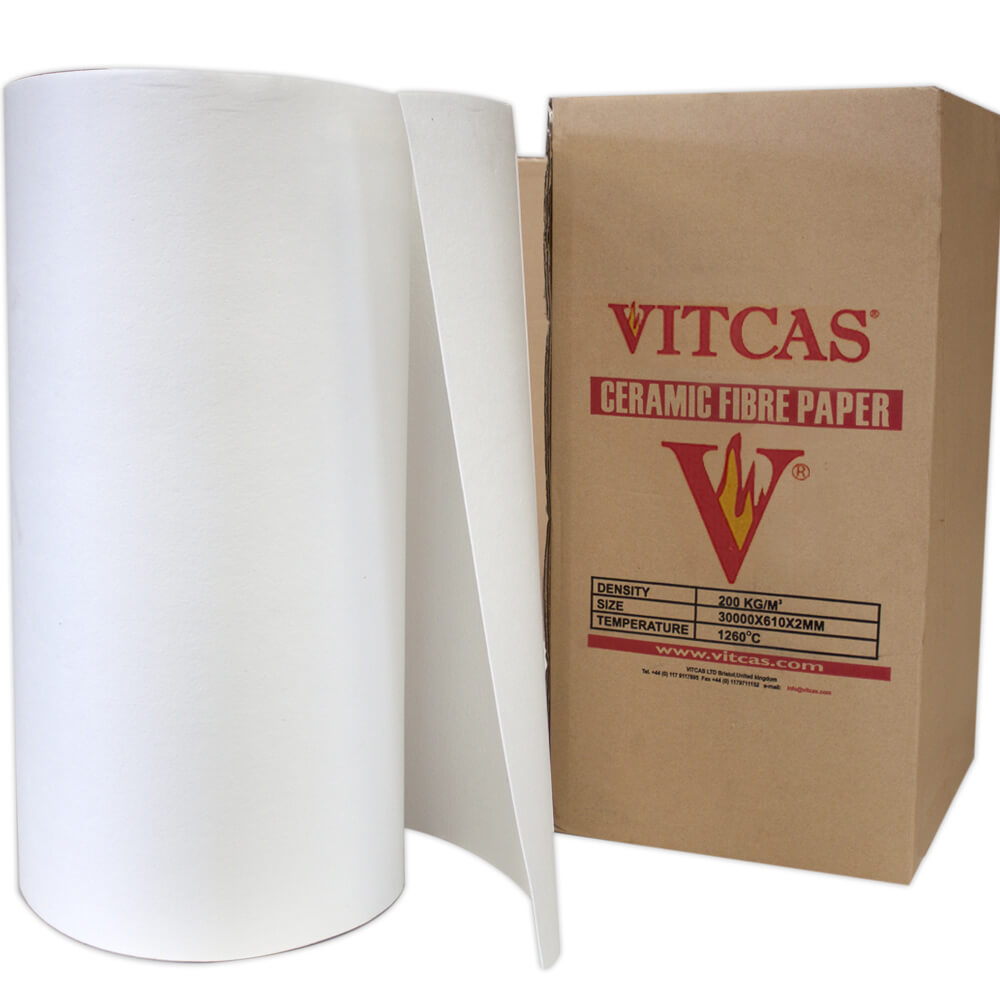
Ceramic fibre paper is useful where a design requires a thin, flexible layer with a defined purpose. It can serve as a separator, gasket material or supplementary insulation. Its small thickness does not make it a replacement for any rigid board or the main insulation of a furnace.
Check the exact fibre variant
Vitcas Ceramic Fibre Paper is described as aluminosilicate fibre paper with a stated resistance up to 1260°C. Other fibrous materials are also available. Check the properties of the selected variant in its current data sheet rather than relying on the product family name or web address.
Before ordering, establish the thickness, width and installation location. Consider compression, movement between components and exposure to flowing gases. These conditions affect how the separator must be fitted and retained.
Specify its role in the detail
The manufacturer's applications include suitable flue inspection-door seals and supplementary layers in industrial equipment. The particular connection needs a confirmed design. A sheet alone does not establish the required seal or closure arrangement.
Other formats, such as a suitably selected ceramic fibre blanket, can provide the main insulation around a curved chamber. Thick blanket and thin paper have different geometries and duties. Check a proposed change before substituting several sheets for the specified layer.
Plan fitting and first heating
Consult the current safety data sheet before cutting. Dry-fit the material and confirm the required compression, enclosure and fixing. Avoid leaving it where loose fibres could reach a working surface or airflow.
Check the first-heating requirements and binder behaviour for the particular variant. At handover, compare the installation with the detail drawing. Record the material and thickness so a future replacement can be selected from the specification rather than the appearance of a worn sample.